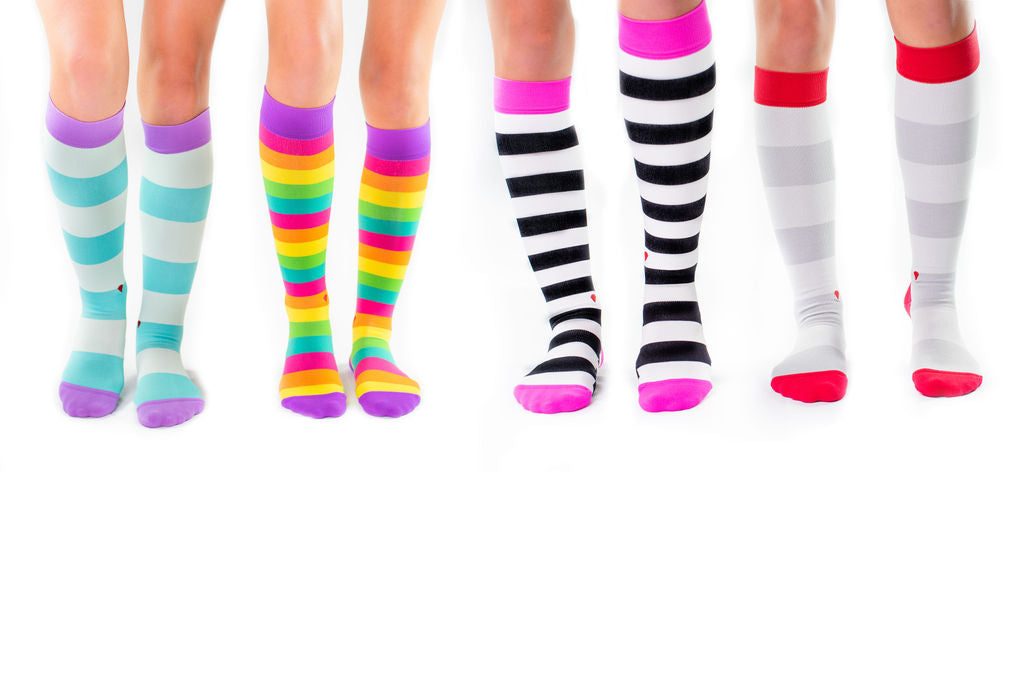


It starts with a color. Or a shape. Or something I saw three weeks ago that my brain has apparently been quietly saving for later.
People ask where I get ideas for socks, and the truth is: everywhere.
Sometimes I'll see a color I love. Sometimes it's two colors together, maybe in a piece of art, that make my brain light up. Other times I'll notice the shape of something, or an entirely different style, and suddenly it connects with an idea that's been floating around in my head for weeks.
And sometimes I dream about something weird and wake up with a sock design.
My brain is always buzzing with ideas. It's the artist in me, I guess.
What's funny is that once I've turned an idea into a design, I often can't remember where it originally came from. It's almost as if the inspiration has served its purpose and my brain promptly tosses it in the trash to make room for something else.
But occasionally the whole thing arrives at once.
That's what happened with our Elevated Casual collection. I saw a couple of completely disconnected images on Pinterest and immediately knew how they belonged together. There was no long period of contemplation. My brain had already assembled the collection before I had time to catch up.
Other ideas take their sweet time.
I might notice two colors that look incredible together, but there's no sock there yet. So they sit somewhere in the strange filing cabinet inside my brain until, weeks later, I see a shape or a pattern or something completely unrelated and suddenly:
QUICK. GET THE IPAD.
And that's when the actual work begins.
Chaos, Before the Chaos
Once I know what I want to make, I draw it.
And while the finished design might look fairly simple, what I send to my manufacturer is more than a picture of a cute sock with a note that says, Please make this.
I get specific.
For a striped sock, for example, I'll specify the width of the stripes. The stripes on the sole might be a different width than the stripes on the body. I'll show where the colors change at the cuff, heel and toe. I'll include different views. I'll specify colors using Pantone numbers.
The goal is to remove as much guesswork as possible.

Chaos, before the chaos.
And it works.
Usually, the first sample is fairly close to what I imagined because the manufacturer had a very specific roadmap to begin with.
Then I wait.
A Month Later, a Sock Appears
Samples usually take about a month to arrive.
And this is where a design stops being a drawing and has to prove that it can actually be a sock.
I wear it.
I walk around in it. I pay attention to the fit, the stretch, the thickness, the construction, the cuff, the way the design looks when it's no longer lying flat. I wash it. I dry it. I make notes about what I love and what I don't.
But really, all of those individual questions roll up into one much simpler test:
Would I like this enough to add it to my sock drawer?
If the answer is no, I'm certainly not going to ask someone else to pay for it.
Sometimes the changes are relatively minor and the design needs another sample. Other times, the answer is simply that the sock isn't going to work.
That happens more often than you might think.
I intentionally sample more designs than I plan to produce because I know some of them won't survive this part of the process. In a recent batch, for example, I sampled a set of Pilates socks that I really liked as a concept.
They didn't work.
There wasn't anything catastrophically wrong with them. The construction simply couldn't support the design the way I wanted it to.
And that's okay.
Not every good idea makes a good sock.
There is something very useful about learning that when you make physical things. An idea can work beautifully on an iPad and fail completely once yarn, elastic, machinery, gravity and an actual human foot get involved.
You don't have to force it.
You just make another sock.
Then the Sock Needs Clothes
Once I'm happy with a sample and know we're moving into production, I send the project over to Kim, Ruby's graphic designer, for the belly bands.
There are certain pieces of information that have to be there: fiber content, our RN number and the other less glamorous bits of information required on product packaging.
Beyond those parameters, I usually give Kim complete creative freedom.
This is one of my favorite parts of working with other creative people.
I can be incredibly specific when I know exactly what I want. I will happily tell a manufacturer precisely how wide a stripe should be and give them the Pantone number for the pink I have in mind.
But I don't need my fingerprints on every decision.
Kim is very good at what she does, so unless I have a particular concept for a collection, I give her the information she needs and let her run with it.
She always does a great job.
Then comes the slightly less romantic part of designing socks:
ordering a lot of socks.
Welcome to the MOQ
In manufacturing, there's something called an MOQ: minimum order quantity.
This is the number of units a manufacturer requires you to order before they'll produce something.
For Ruby's casual socks, that's 100 pairs per size, per style. Since I currently produce them in small and medium, a single casual design generally means committing to 200 pairs.
Compression socks?
1,000 pairs.
One. Thousand. Pairs. Of. Socks.
😱
This is the point at which a cute drawing on an iPad becomes a business decision.
Because when you're designing, you can make anything you want. You can play with colors and patterns and happily create twelve different versions of something.
Manufacturing eventually asks a much less whimsical question:
How many of these would you like to pay for?
Suddenly you're very interested in whether you really like that stripe.
Once the order is placed, production generally takes four to six weeks. Shipping takes about another two. I plan on roughly two months between placing a production order and receiving it.
And then one day...
The Socks Come Home
For now, Ruby's production orders are delivered directly to my house.
Boxes are one thing.
Pallets are another.
There is a peculiar moment in entrepreneurship when an actual pallet full of something you created arrives at your home and you are confronted with the physical consequences of your own decisions.
There they are.
Hundreds of them.
Something that started as a color I noticed somewhere. Or two unrelated pictures. Or a shape. Or a strange idea my brain decided to hand me while I was doing something completely different.
Something that, for a while, existed nowhere except in my head.
Then it became a drawing on my iPad.
That drawing traveled to a manufacturer and became a sample. The sample came home and spent some time on my feet. It went through the washer and dryer. Maybe I changed it. Maybe another sample was made. Kim designed something beautiful to wrap around it. I placed an order and waited while hundreds of identical versions were made and shipped back to me.
And then I open the boxes.
I still get a little giddy.
“I Drew That.”
Yesterday, my daughter Olivia was wearing a pair of samples.
I looked at her feet and said, “I drew that design.”
Then I pulled up the original file and showed it to her.
She thought that was really cool.
So do I.
For all the practical parts of making a product, the specifications and samples and washing and revisions and minimum order quantities and production schedules and shipping, I don't think that particular part will ever stop being a little bit magical to me.
You can draw something that doesn't exist.
And then, eventually, someone you love is walking around wearing it.
That's how a pair of Ruby socks gets made. 🧦♥️